
Cleaning a Rug on Underfloor Heating
If a rug lies over underfloor heating, it is tempting to clean it in place and let the warm floor do the drying. That shortcut can leave moisture where you cannot see it: in the rug foundation, a bonded backing, an underlay or the floor finish. Warmth at the surface tells you little about those layers. A cleaner's first decision is therefore whether the rug can be moved and dried with air reaching both sides, rather than how high to set the thermostat.

Underfloor heating changes the setting, but it does not make every rug washable or provide a reliable drying method. Fibre, dye, construction and the floor beneath all matter. A thin, colourfast flatweave on tile poses different questions from a heavy wool rug with cotton foundations over engineered timber. This guide explains the checks to make before cleaning, how to handle an accidental spill and when controlled off-site drying is the safer choice.
Understand the layers before adding water
A rug is rarely one uniform layer. The pile may be wool, synthetic fibre or a blend; the foundation may be cotton or jute; a tufted rug may have a bonded backing. A separate pad introduces another layer. Moisture can travel through the face and remain against a backing long after the top feels pleasant to touch. This is why a quick hand check of the pile cannot establish that the rug is dry enough to put back.
Start with the maker's care label, receipt or product instructions. Check both the rug and any underlay. A label that restricts cleaning to professional treatment should take precedence over an attractive home-cleaning method. If the label is absent, do not assume a synthetic-looking pile means the whole construction tolerates water. Our guide to how long rug drying takes explains why thickness and backing influence the time needed.
The floor needs equal attention. Identify whether it is tile, stone, wood, laminate or vinyl, then read the flooring maker's instructions for underfloor heating, mats and standing moisture. Some flooring manufacturers warn that rugs and thick underlays can hold heat beneath them and create local hot spots. The NHBC Foundation also notes that adding carpets and rugs can reduce heat output from an underfloor system. There is no useful universal thermostat setting for an unknown combination of rug and floor. Follow the limits for your particular installation, and ask the flooring supplier if the paperwork is missing.
A heated floor is not a drying rack
Water leaves a damp rug through evaporation and air exchange. Heating one side does not guarantee that moist air can leave the other, especially when a dense rug lies flat against a non-breathable pad or floor finish. The surrounding room still needs ventilation to remove the moisture released from the textile. Government guidance on home ventilation describes how trapped indoor moisture can turn into condensation on cooler surfaces; that principle applies even if the patch of floor beneath a rug feels warm.
Raising the heat to speed up drying also risks uneven treatment. The part above a heating loop may warm differently from a corner beside a wall. The face, foundation and backing do not necessarily expand or dry together. The Canadian Conservation Institute advises avoiding severe or rapid changes in temperature and humidity for textiles and notes that heat can weaken wool threads. A cleaning decision should account for this wider textile risk as well as the flooring manufacturer's temperature limits.
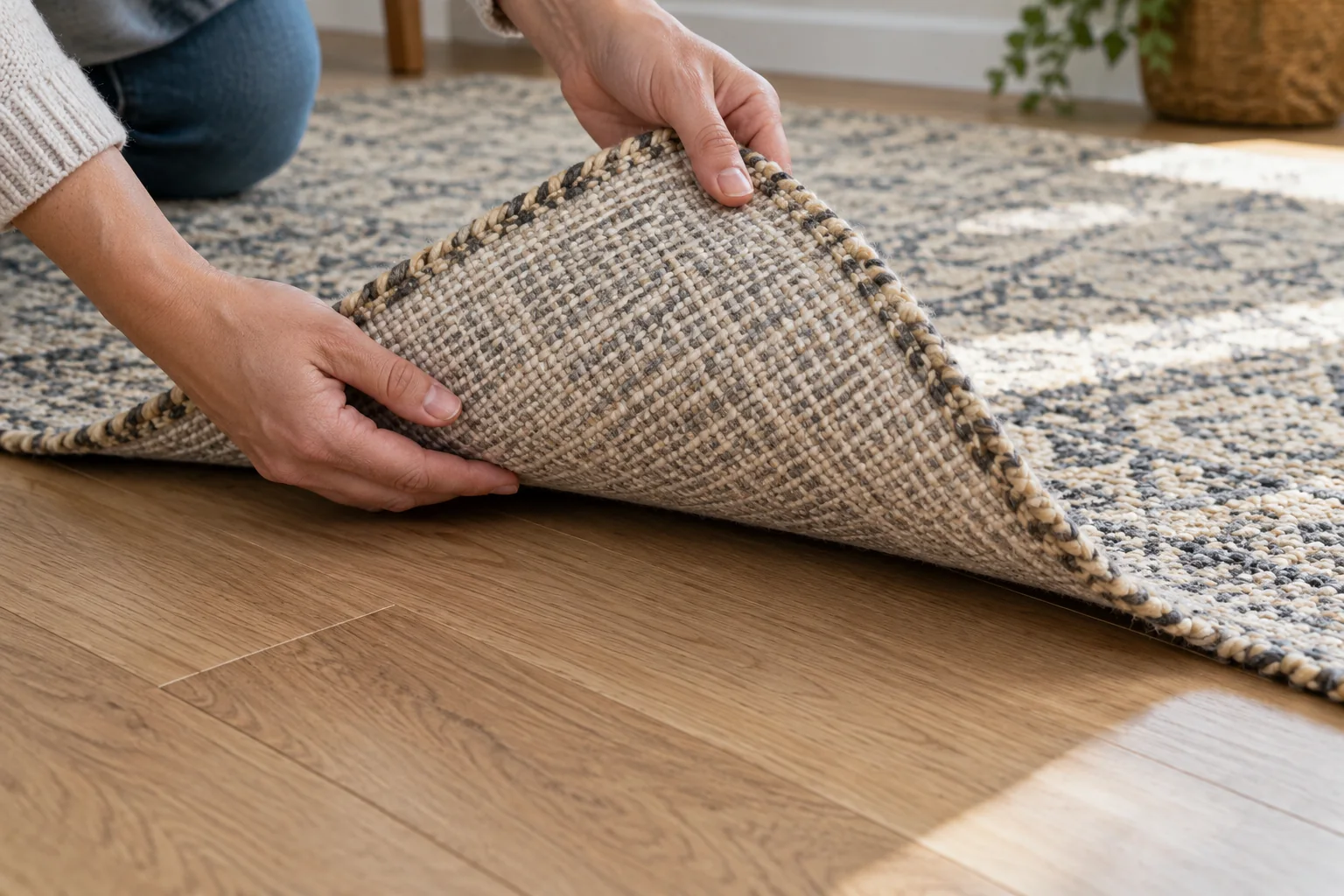
For everyday maintenance, keep dry work dry. Vacuum using a setting suitable for the rug, paying attention to loose edges and fringe. Lift the rug periodically, if its size and condition allow, to check the reverse, underlay and floor. That check is particularly useful after a spill, a wet-shoe season or any change in smell. The Canadian Conservation Institute recommends periodically examining underpadding and the floor beneath rugs, because deterioration there can be hidden from view.
Before cleaning: make a short risk check
First, establish what you are dealing with. Is the rug small enough to lift without bending or dragging it? Does it have a stable woven reverse, or does a powdery or rubber-like backing appear? Are there existing colour runs, loose seams or a musty odour? If any of these signs are present, pause before introducing water. A rug already showing dampness or backing failure needs assessment of the cause, not a routine wash.
Next, look at the floor and heating controls. Note the floor finish, the current settings and whether the rug maker allows that installation. Do not try to make a wet rug dry by overriding the normal heating controls. A particularly thick rug or pad may obstruct heat transfer even when completely dry. If you do not know the floor manufacturer's requirements, avoid using the rug as an experiment; ask the installer or supplier for the applicable instructions.
Finally, plan where the rug would dry. A safely supported position with airflow around the item is more useful than a warm but sealed contact surface. Allow enough clear space to inspect both faces and the floor separately. A large, fragile or valuable rug may be impractical to move or dry in a flat. In that case, professional rug cleaning can include an assessment of the fibre, dyes and construction before selecting a method.
If a small spill lands on the rug
Act promptly, but keep the response limited. Blot liquid with a clean absorbent cloth; do not scrub it through the pile. Remove wet objects from the area and check whether moisture has reached the reverse. If the spill is near an electrical control, outlet or any damaged heating component, address that electrical concern before handling wet materials. Never open or alter the heating installation to investigate a rug spill.
For a light, clean-water spill on a manageable rug, lifting the affected area lets you inspect the pad and floor. If you discover wetness below, separate the layers according to the rug and flooring instructions, and dry the floor as well as the textile. Protect an absorbent floor finish from prolonged contact with damp material. Do not cover the wet area with plastic or put the rug back simply because the face looks normal. A deeper spill, coloured liquid or unstable dye calls for earlier specialist advice.
Avoid adding detergent, vinegar, fragrance or a second round of water just to chase a mark. Each addition can enlarge the wet zone or complicate later treatment. A photograph of the spill, the rug label and the floor area gives a cleaner more useful information than an uncertain account of products used afterwards. Our article on DIY rug cleaning mistakes covers the damage that can follow aggressive spot work.
Dry the rug and the room as separate tasks
After any cleaning that introduces moisture, the goal is to remove that moisture from the whole rug while keeping the floor protected. A professional process may use controlled extraction and a drying area that supports the textile evenly. At home, a small robust rug can sometimes be moved to a suitable dry space, but do not hang a heavy wet rug over a narrow rail: its weight may distort the weave or fringe. Do not fold it tightly while damp. If you cannot support it without stress, arrange professional help.
Use appropriate room ventilation so moisture does not accumulate. Open available vents or use existing mechanical ventilation as intended, taking account of the weather and the building. Gentle air movement around a safely positioned rug can help, but a fan cannot remove moisture sealed between the rug and floor. A dehumidifier can assist with the room air; it cannot prove that a thick backing has dried. Inspect the underside, pad and floor rather than relying on a single surface touch test.
Do not place the rug on a radiator, aim a high-heat appliance at it or turn up the underfloor system as a substitute for airflow. Such methods can heat one part sharply while another stays damp. Leave the heated floor uncovered until its surface is clean and dry, and return the rug only when the textile, pad and floor are all dry and the installation instructions permit the combination. If the underside remains cool, damp or odorous while the face feels dry, keep the layers separated and seek advice.

Watch for signs that the problem goes beyond routine cleaning
A damp smell that returns when the heating starts, a patch that repeatedly feels wet underneath, discolouration of the floor, or a backing that sheds powder deserves investigation. The rug may not be the original source of moisture. Condensation, a leaking pipe, trapped spill water or a problem with the floor assembly can all make a rug seem to have a cleaning problem. Cleaning the visible face will not resolve a continuing source below it.
Mould or a persistent musty odour also changes the task. Avoid repeatedly wetting the item or masking the smell with perfumed products. Keep the rug away from clean floors and fabrics while arranging an assessment of both the textile and the building source. If the floor is damaged or the heating installation might be leaking, contact the relevant qualified trade as well as a rug specialist. A rug cleaner cannot repair a building leak, and a flooring inspection will not by itself determine whether a rug can be safely cleaned.
If you are unsure whether your rug can be cleaned and dried safely over underfloor heating, contact our team with photographs of its face, reverse, label and the floor beneath it. We can discuss the rug's construction and the likely cleaning approach; your floor or heating supplier should confirm any installation-specific limits. Taking those two decisions separately protects both surfaces and avoids treating thermostat warmth as proof of dryness.
Related Rug Cleaning Services
Explore professional cleaning options selected around the fibre, construction and condition of each textile.
Rug Cleaning Near You
View local rug cleaning information, appointment guidance and coverage across popular London districts.
Continue Reading
Read more practical guidance about fibres, stains, cleaning methods, drying and routine rug care.
Send us rug photographs and a few details.
Include the approximate dimensions, material if known, stain information and your London postcode.