
Traffic wear
Check for pile loss, flattening and exposed foundation along the central walking route.
Hallway runners sit in some of the busiest areas of a home. They collect grit from shoes, moisture from entrances, pet hair, dust and concentrated traffic wear. Their cleaning needs depend on fibre, construction, backing, dye stability, condition and how securely the runner sits on the floor.
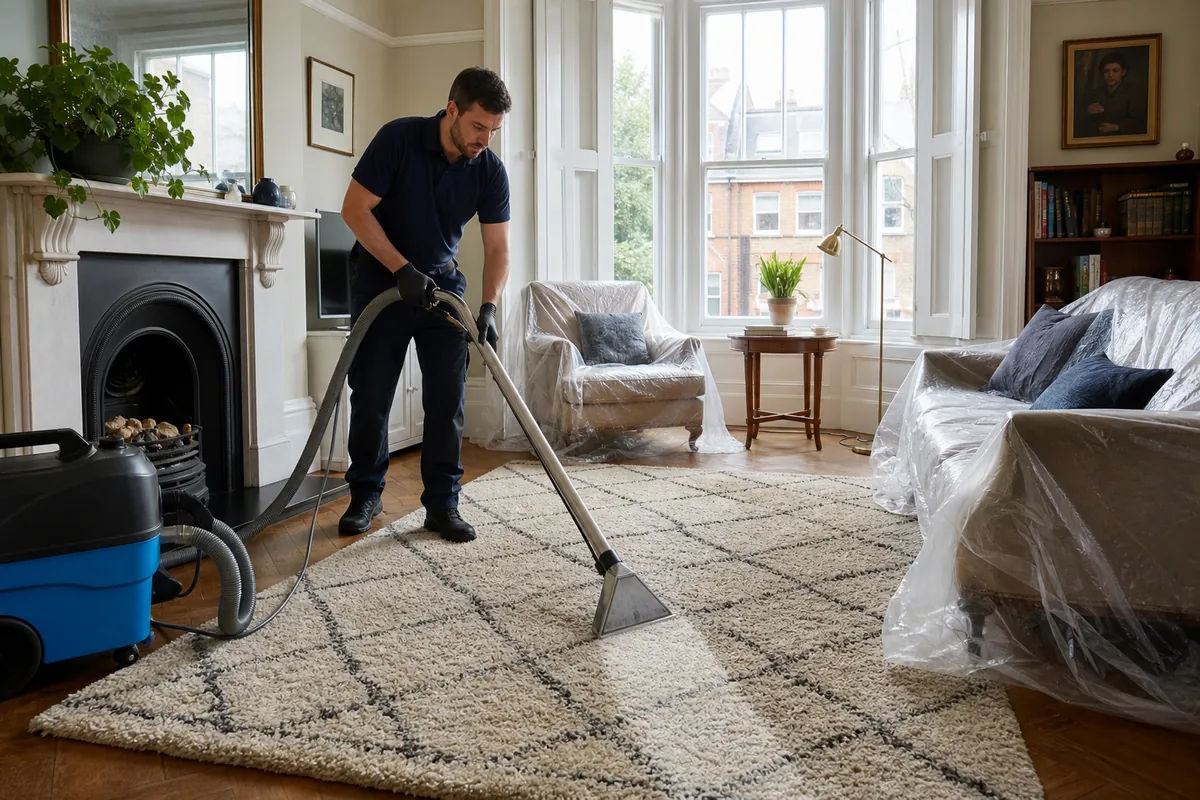
Entrances, narrow hallways and stair approaches often hold more grit and moisture than other parts of the home.
A hallway runner may appear dusty on the surface while holding a much larger amount of grit around the base of the pile. Every step presses that soil against the fibres, which can contribute to premature wear, flattened traffic lanes and dull colouring.
The runner should also be checked for slipping, curling edges, damaged fringes, backing failure and colour instability. A suitable cleaning process should consider the complete textile and the floor beneath it.
Hallways connect entrances, kitchens, living rooms and staircases. This means runners receive repeated foot traffic from several directions. Dry soil from outside, pet hair, crumbs, fine road dust and moisture can build up quickly.
The central walking lane usually becomes visibly flatter and darker than the edges. This contrast is not always caused by staining. Compression, fibre wear and light reflection may also make a traffic lane appear different after cleaning.
Hallway runners may be made from wool, cotton, synthetic fibres, viscose, silk blends or mixed materials. They may be hand-knotted, flatwoven, machine woven, tufted or manufactured with an adhesive backing.
A wool runner may tolerate a different process from a viscose or silk-blend runner. A hand-tufted runner may contain ageing adhesive, while a flatwoven runner may be more prone to dimensional change. The visible pile alone does not determine the safest cleaning method.
Check for pile loss, flattening and exposed foundation along the central walking route.
Inspect for cracking, adhesive dust, separation, previous tape and non-slip backing residues.
Look for curling, split ends, loose binding and areas that may catch under shoes.
Check whether moisture, rubber backing or previous spills have affected the floor beneath the runner.
The runner should be turned over so the reverse, backing and edges can be inspected. Dry soil often passes through the pile and settles between the runner and the floor.
The reverse can also reveal water marks, urine contamination, backing deterioration, repairs and uneven wear. Measurements may be recorded where shrinkage or shape distortion is a concern.
Fine grit acts abrasively when people walk over the runner. Even where the top looks reasonably clean, particles may remain around the base of the fibres and within the foundation.
Dry soil removal should normally take place before wet treatment. The level of vibration or mechanical action should be adjusted for the runner’s age, construction and condition.
Runners near front and back doors often receive wet-weather soil, salt residue, mud and moisture from footwear. Repeated dampness can create tide marks, odour and soil concentration near the entrance.
A runner should not remain damp against wood, laminate or delicate stone flooring. Moisture below the textile may affect both the rug and the floor, particularly where ventilation is limited.
Hallways are common travel routes for pets, so hair and dander can accumulate along the edges and beneath the runner. Urine may pass through the pile and contaminate the backing or floor below.
A surface deodoriser may reduce the smell temporarily without treating the source. The extent of contamination should be assessed before deciding whether local treatment, deeper cleaning or off-site care is appropriate.
After cleaning, the runner should be returned only when fully dry and positioned securely. Curling edges, unsuitable underlay, deteriorated rubber backing and loose placement can create a trip or slip hazard in narrow hallways.
Hallway runners may collect tea, coffee, drinks, grease transferred from shoes and marks from cleaning products. Old spills may have already affected the dye or fibre.
A fresh spill should normally be blotted rather than rubbed. Aggressive rubbing can spread contamination, distort the pile and create a larger visible patch. Complete stain removal cannot be guaranteed where permanent fibre or dye damage has occurred.
A durable, colourfast wool or synthetic runner may tolerate controlled extraction. A viscose, silk-blend, unstable or structurally weakened runner may require lower moisture and gentler handling.
The cleaning method should reflect the depth of soil and the condition of the complete runner. Surface maintenance, heavy grit removal, pet urine treatment and restoration-level care are different objectives.
Long and narrow rugs should dry evenly to reduce the risk of rippling, curling and dimensional change. Airflow should reach both the surface and reverse where the method allows.
The runner should not be returned to the hallway while the backing remains damp. Walking on a partially dry rug can transfer soil, flatten the pile and delay drying.
The safest process depends on fibre, backing, dyes, condition and the type of contamination present.
| Method | May suit | Main consideration | Drying |
|---|---|---|---|
| Controlled extraction | Stable wool and synthetic runners | Moisture must suit the backing and floor | Moderate |
| Low-moisture cleaning | Selected maintenance cleaning | May not remove deeply embedded soil | Usually shorter |
| Dry compound treatment | Selected moisture-sensitive runners | Limited for heavy staining and urine | Short |
| Off-site rug care | Complex, valuable or heavily soiled runners | Requires transport and physical inspection | Controlled |
No. Suitability depends on the fibre, backing, dyes, construction, condition and the floor beneath the runner.
The central lane may contain permanent wear, pile flattening or fibre damage in addition to removable soil.
Some runners may be suitable for controlled in-home cleaning. Others may be safer to treat off-site, especially where the floor requires protection.
Many can be improved, but the result depends on the fibre, age of the mark, previous products and any permanent abrasion.
It depends on whether contamination remains only in the pile or has entered the backing and flooring below.
Use a suitable setting, vacuum in the direction of the pile and avoid pulling fragile fringes into a rotating brush.
It should be fully dry on both sides and positioned securely before normal foot traffic resumes.
Send the length and width, photographs of both sides, fibre information, stains, pet issues, backing condition, access and postcode.
Send photographs, dimensions and details of entrance soil, stains, pet contamination or damaged edges.