
Rug Pads on Timber Floors: Moisture and Marks
An underlay can help a rug stay in place and soften the pressure of furniture on its pile. On a timber floor, however, the material beneath the rug deserves as much attention as the rug itself. Some pads can leave a pattern on a floor finish; a non-breathable layer can hold moisture after a spill or cleaning. A covered patch of timber may also age differently in sunlight from the exposed floor around it. These effects have different causes, so choose and check the pad with the floor finish in mind.

The right underlay depends on the rug, the timber finish and the maker's instructions for both. A label that says “non-slip” does not establish that its rubber, adhesive or coating will suit a particular finish. This guide sets out useful questions to ask before purchase, routine checks and what to do if a mark appears.
Why a pad is useful in the first place
A suitable pad can reduce sliding, cushion unevenness and help distribute some pressure under furniture. It also creates a layer between rug and floor that may catch grit for removal during cleaning. The Canadian Conservation Institute's basic rug guidance describes the protective role of underlay, while advising regular checks and warning against several materials for valuable rugs. Its specific recommendations address conservation priorities; a modern household rug and timber finish still require their own compatible product.
A pad should lie flat without folds or overlaps. A ridge beneath the rug can show on the surface and focus wear along one line. An undersized pad may leave the rug edge unsupported, while an exposed pad can catch shoes. Follow the rug maker's dimensions and the pad maker's fitting instructions; do not glue a pad to the finished floor as a quick fix for slipping.
Before placement, clean dry grit from both sides. Sand or hard particles trapped underneath can abrade the finish as people walk. Lift furniture rather than dragging it across the rug and timber. A pad does not substitute for stable furniture feet or sensible room layout.
Choose for breathability and finish compatibility
The National Wood Flooring Association's installation guidance recommends breathable throw rugs on wood and cautions against non-breathable floor coverings. It also warns that some non-slip pads can imprint their pattern on a finish or wood floor. This is especially relevant when a rug lies over a recent finish, where the floor manufacturer's curing and covering instructions should take priority.
Ask the retailer whether the pad is approved for your particular finish, not just for “hard floors” in general. Lacquered, oiled, waxed and factory-finished timber can have different compatibility advice. Request material details and keep the packaging. A pad with a tacky coating may offer strong grip but be a poor choice if the floor maker prohibits direct contact. A plain breathable pad that moves excessively may also be unsuitable; the answer is a compatible product and proper fit, not an improvised adhesive.
The Institute's rug guidance cautions against self-adhesive underlays and several foam or vinyl options for important rugs. That is a conservative preservation position, not a blanket verdict on every modern commercial product. Treat it as a reason to check both rug and flooring instructions and to inspect the result rather than assuming a material name guarantees safety.
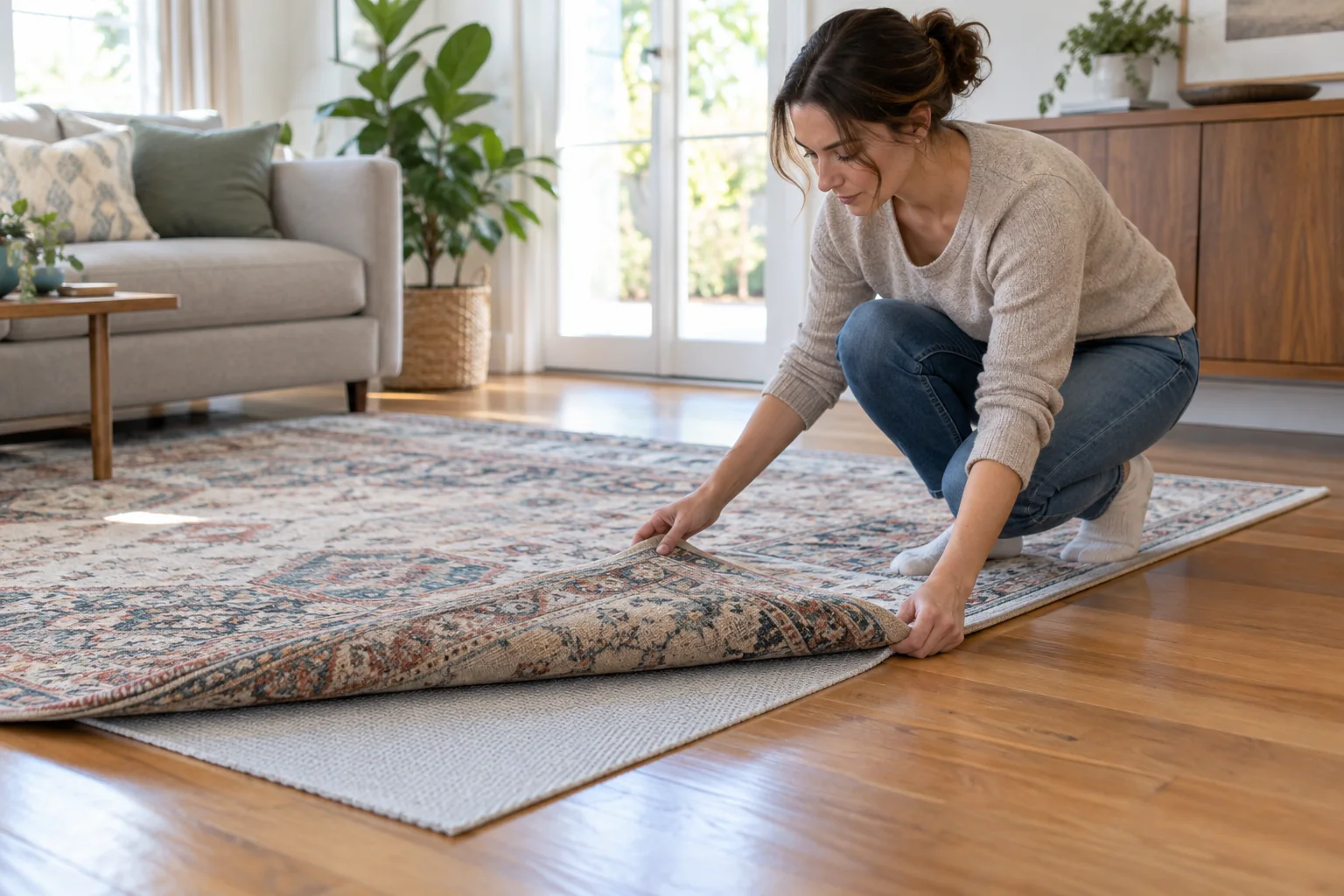
Check for trapped moisture after spills and cleaning
A drink can pass through the pile and remain between rug, pad and timber. The visible rug face may feel dry first. Lift a manageable corner carefully and inspect the reverse, both sides of the pad and the floor. If any part is damp, separate the layers and let them dry appropriately before reassembly. Do not put the pad back because the top of the rug has stopped feeling wet.
The National Wood Flooring Association says rugs should be thoroughly dry before being placed on wood floors. Its wood-floor problem-prevention guidance also explains that wood gains moisture and can swell in humid conditions. A damp mark may therefore be a floor issue as well as a rug issue. If there is a continuing leak, address the source; a rug-cleaning appointment alone will not stop it.
Keep hot appliances and direct heater air away while drying. Heating one small patch of rug or floor rapidly can create uneven conditions and may affect a finish. Use ordinary ventilation and follow the floor maker's advice for any wet area. If a large area is affected, the rug is heavy when wet or the floor appears to swell, seek professional floor and rug advice promptly.
The article on how long rug drying takes gives wider context for checking the whole construction after cleaning. A promised number of hours is not a substitute for confirming that the backing, pad and timber are dry.

A floor mark has several possible explanations
A grid or dot pattern matching the pad may indicate imprinting or a reaction with the finish. A dark patch after a spill may reflect retained moisture or transferred dye. A lighter rectangle where the rug sat may be protected timber that received less sunlight than the surrounding floor. These situations need different remedies, and a rug cleaner should not claim to repair an altered floor finish.
Photograph the whole floor area, the underside of the rug and both sides of the pad before moving or replacing anything. Record the pad brand and material, floor finish if known, length of use and any spills or cleaning dates. Do not scrub the mark with solvent or an abrasive pad while its cause is unknown. The floor maker or a qualified wood-floor professional may need to advise on finish compatibility and restoration.
If colour from the rug has transferred, tell the rug cleaner too. A damp dye problem may still be active in the textile. Keep the layers apart so the same contact does not continue. The handmade rug care guide notes wider handling concerns; a valuable rug may need especially cautious lifting and drying.
Make routine inspection part of cleaning
When vacuuming or rotating the rug, check one or two corners of the pad and floor. Look for powder, a tacky feel, grit, dampness, smell or a visible pattern. Clean the floor according to its finish maker's instructions and let it dry before laying the pad back. Clean the pad as its maker directs; replace it if it is degrading, leaving residue or slipping.
Rotation can help distribute rug traffic and light exposure, but it exposes a previously covered area of timber. The National Wood Flooring Association notes that covered wood can differ in colour from wood exposed to light. That difference may be a normal consequence of covering, not a stain left by the pad. Photograph the floor when moving a long-standing rug so the change is documented.
For a rug-cleaning assessment, mention the timber floor and pad as well as the rug. Ask how the rug will be dried before it returns and whether its backing will be checked. Use the contact page to share photographs of any mark. A professional may advise on the rug while referring floor-finish questions to a flooring specialist.
Keep both surfaces in the plan
A pad is helpful when it is flat, compatible and dry. Its value comes with a small maintenance task: check beneath it, especially after wet cleaning or a spill. Choose with the floor finish in mind, keep grit out, allow every layer to dry and document a mark before attempting a fix. That approach protects the rug and the timber instead of treating the pad as invisible once it is laid down.
Related Rug Cleaning Services
Explore professional cleaning options selected around the fibre, construction and condition of each textile.
Rug Cleaning Near You
View local rug cleaning information, appointment guidance and coverage across popular London districts.
Continue Reading
Read more practical guidance about fibres, stains, cleaning methods, drying and routine rug care.
Send us rug photographs and a few details.
Include the approximate dimensions, material if known, stain information and your London postcode.