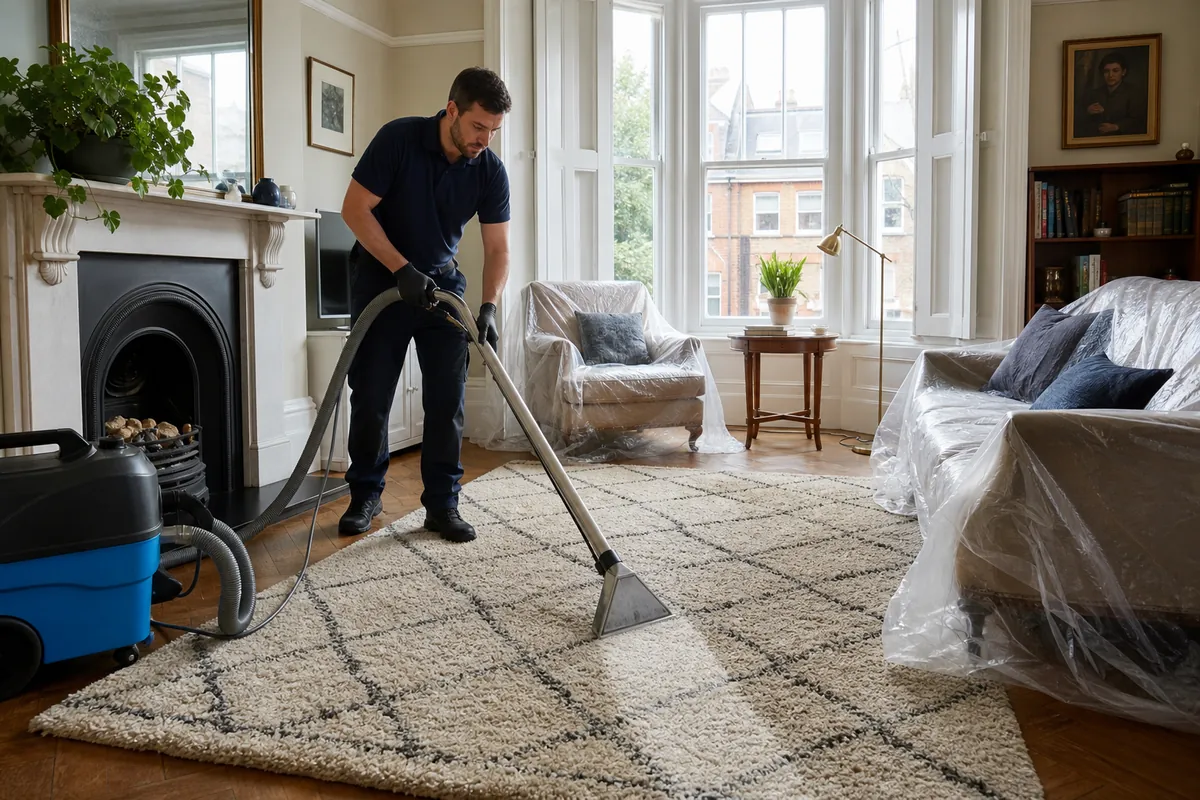
We clean suitable rugs in Brixton with portable machine extraction at your property. The process introduces moisture and needs drying; we do not offer dry cleaning. We assess the textile and any loose-material incident, prepare the accessible surface and complete suitable treatment and liquid recovery, with the result and room arrangements explained.
Mobile service in Brixton · Cleaning method agreed after inspection
Particle preparation within the actual extraction service
Material scattered across a rug can be the first visible concern while other soil remains in its fibres. We assess both parts of the request before agreeing work. Suitable preparation removes accessible loose particles ahead of the wet sequence, rather than the rug simply receiving liquid as the first response. That preparation has a defined role but is not the complete cleaning process. We explain the actual extraction service and the moisture it introduces so the appointment is considered on clear terms from the outset.
Our portable equipment is brought to the property and the rug remains there during cleaning and drying. We inspect material and condition, organise access and choose appropriate local attention before application and recovery. The machine takes used cleaning liquid away with released dirt; moisture still within the textile evaporates afterwards. At completion we discuss the actual response, relevant limits and practical use of the room. The customer receives a complete removal service for the accessible item rather than a promise based only on visible particles or a requirement to select technical settings before the rug has been assessed.
Locating the material and describing the whole request
We ask where the material landed and what is known about anything that happened afterwards, including products or attempts already made. An overall image and approximate size help identify the rug, with closer views locating concerns within the design. Reliable care details and repairs provide further context. A cause that is uncertain stays open rather than being assigned from particle colour or feel. The enquiry prepares the assessment without requiring the customer to shake a fragile textile or disturb an unfamiliar feature to demonstrate the amount present.
The proposed work describes the wider cleaning priorities too. General dirt and local marks can sit alongside visible loose material when a broader clean is requested. Furniture coverage and movement are discussed explicitly, and other rugs have their own descriptions. This gives the quotation recognisable boundaries. On arrival, inspection confirms the suitable process, included area and charge before application, with any adjustment explained. The service is therefore a definite clean on accessible surfaces rather than an unlimited instruction about every particle, hidden section or physical change associated with the incident.
Assessing the textile before liquid is used
We inspect the visible fibres and accessible support, including borders, fringes and known repaired areas. Relevant checks of material and colour response guide extraction suitability and handling. A surface that looks robust can still have a weaker edge or supporting feature, so the actual construction is considered as a whole. We explain how the findings affect the proposed work. The customer can understand the decision without identifying every component or prescribing technical action from the rug’s decorative style, pile depth or the amount of material visible on top.
Our cleaning goal is useful contamination removal within the item’s present condition. Fading, lost pile and damage can remain after dirt is recovered, while a weakened feature may restrict or prevent extraction. Relevant limits are identified before agreement, and unsuitable treatment is declined rather than another method substituted. On a suitable rug, preparation and local attention support the actual wet process. This keeps an improvement in loose-particle appearance from being mistaken for completion of every cleaning need or a promise that each protected and exposed section will finish identically.
A clear basis for the actual service
Detail
What we establish
Purpose
Incident observation
Location and known earlier actions
Relevant context
Actual rug
Construction and response
Extraction suitability
Loose particles
Accessible material and condition
Suitable preparation
Physical features
Wear or lasting change
Realistic limits
Taking accessible loose material out first
We carry out suitable vacuum preparation using handling selected for the checked texture and strength. The route follows the surface agreed with the customer, including reachable ends rather than only the most obvious scatter. Vulnerable edges and finishing details are considered throughout, avoiding forceful handling simply to make an area look clear. Particle removal supports the main clean and helps reveal what still needs attention within the fibres. It is an actual stage of the company service, not a separate process or a way of removing the later drying requirement.
We arrange the working space alongside that preparation. The floor below the rug, room for the operator and the route and position of portable equipment are considered before application. Furniture movement follows the agreement, while covered portions stay clear in the accessible scope when items remain. These details make the proposal practical to carry out. A hidden continuation or awkward border can then be accounted for in advance, instead of the extent of the clean becoming uncertain after the machine has already started over the open centre.
Illustrative home setting: the individual textile guides preparation and treatment.
Assessing the concerns that remain after preparation
Once suitable loose removal has been completed, we examine remaining local marks with their surrounding fibres and checked response. Known spills or earlier products help where available; uncertainty remains clear. Selected attention is intended to release residue that the actual textile can appropriately receive treatment for. We explain the purpose and likely limitations within the broader clean. The fact that particles were visible does not establish the cause of every patch, nor does one remaining dark area automatically justify a stronger product or repeated action without regard to the construction.
We observe the local response and connect released material with extraction recovery. Another suitable step is considered when it offers a worthwhile benefit, not simply because a contrast is still noticeable. Permanent fibre or dye alteration can persist after residue is addressed, which we explain plainly. The review recognises actual improvement and partial response where relevant alongside general soil removal. This keeps the original concern within the account without an unconditional disappearance claim or the wider clean being reduced to the outcome of one old physical feature.
Carrying out the moisture-bearing machine clean
The portable extractor applies the selected cleaning process to suitable fibres and retrieves used liquid carrying released dirt. Our operator organises the route in sections that can be worked properly, choosing technical action from the inspected construction and response. Reachable borders and areas beside furnishings retain their place where included. We explain the equipment’s purpose while keeping responsibility for operation with the company, rather than asking the customer to determine settings or choose application intensity from the substance description, a photograph or a general method name alone.
Extraction introduces moisture and the item must dry at the property after recovery. We continue watching its response during work, with weak features and physical differences from inspection still relevant. More liquid cannot reconstruct worn pile, replace lost colour or repair a damaged foundation. Suitable attention follows contamination that can usefully respond within the rug’s limits. The process remains a defined release-and-removal service on the actual textile rather than a repeated attempt to make all surfaces appear identical or an implication that vacuuming beforehand makes the whole appointment moisture-free.
Illustrative extraction with cleaning-liquid application and machine recovery.
Collecting used liquid across the agreed rug
Recovery gives the dirt-bearing solution a route from the fibres into the equipment. We assess collection while following the planned area and make suitable additional recovery passes where needed to reduce moisture left for evaporation. Application therefore leads into active removal rather than being presented as the finished task. We account for the accessible portions agreed, including quieter ends. The customer can understand how collection completes the purpose of preparation and local treatment, with dirt taken away over the proposed surface instead of a central wet pass representing the whole clean.
We compare the result with the condition observed before starting. A busy route can retain a different texture or colour from a sheltered section once removable soil has gone. The incident-related area may also have a particular response. Relevant physical features are explained rather than every contrast being described as residue needing more treatment. Further suitable attention needs a useful cleaning purpose, not just an aim of forcing worn and protected fibres into a visual match. This gives a balanced account of improvement on the actual rug the customer introduced.
Reviewing the actual response beyond the loose particles
The closing check returns to the priorities agreed before application. We discuss local attention and the wider clean, with appropriate finishing where suitable for the material. A persistent issue is explained using the findings and response observed, not an unsupported cause. Covered sections are accounted for, and a detail better assessed when dry is identified where useful. This provides a specific account of the whole service rather than simply stating that visible particles have gone or the extractor has made its final pass over the open surface.
The review also distinguishes useful dirt removal from continuing physical condition. A faded region, older repair or worn edge may remain part of the rug after cleaning. Questions about that feature can be considered directly while the item and its response are available to examine. With additional textiles, each outcome stays identifiable rather than combined into a blanket statement about the room. This connects the original incident and proposed work with what actually happened at the property, leaving a practical basis for understanding the dry appearance instead of assumptions from a service label.
The extraction process and drying
Stage
Company action
What it means
Prepare
Recover suitable particles
Before liquid application
Extract
Apply and collect solution
Moisture introduced
Review
Discuss actual response
Result and condition clear
Drying
Consider textile and room factors
Remaining stage at home
Explaining drying and planning the Brixton visit
The customer also needs an explanation of the period after recovery, when moisture continues to leave the textile. We discuss the item’s thickness and construction together with the conditions in the room, including relevant air movement, furnishings and everyday activity. That makes the information useful for the actual setting rather than a fixed timetable attached to a rug category. It also shows why completed machine removal and full ordinary use need not be simultaneous. The remaining stage is understood before equipment is packed away, with the rug drying at the property.
We establish equipment access before attendance. Entry, parking and floor level are discussed, with lift or stairs where needed. Working space and furniture movement are agreed explicitly, and extra items can have a sensible order while their material decisions remain separate. Inspection confirms suitable work and charge before application. These arrangements support an organised appointment in which the team can focus on the actual textile once inside, connecting access, the agreed extraction sequence and drying instead of basic route or scope questions being left to interrupt the main treatment at the property.
Machine extraction cleaning price guide
Use these starting prices as a guide. Share the item size, condition and access details so the work and final quote can be confirmed.
Service
Published starting price
What is included
Timing
Carpet cleaning
From £25 per room
Inspect, pre-treat, clean
Room dependent
Rug cleaning
From £20 per rug
Inspect, assess spots, clean
Size dependent
Steam rug cleaning
From £25 per rug
Check suitability, extract
Varies
Oriental rug cleaning
From £35 per rug
Fibre, dye and condition checks
Varies
Luxury rug cleaning
From £40 per rug
Assess and select method
Varies
Mattress cleaning
From £30 per mattress
Inspect and clean fabric
Varies
Upholstery cleaning
From £12 per seat
Check fabric and clean
Varies
Sofa cleaning
From £35 per sofa
Assess fabric and clean
Varies
Arranging machine extraction rug cleaning in Brixton
We identify the requested item, incident observations and wider priorities, agree available surfaces and organise practical equipment access. Work and charge are confirmed after inspection and before application. Additional textiles receive separate descriptions and suitability decisions.
Local postcode districts: SW2, SW9. We confirm the visit against your full address.
No. We provide on-site machine extraction only. It introduces moisture and requires drying afterwards at the property.
Is particle preparation the whole cleaning process?
No. Suitable vacuuming removes accessible loose material before selected local work and the main application-and-recovery sequence.
Can an incident with uncertain material be discussed?
Yes. Explain what is known and where it was noticed. We inspect the actual rug and keep uncertain causes clear rather than assigning them from appearance alone.
Does every rug receive extraction?
No. Construction, colour response and present condition guide suitability. We explain restrictions and decline inappropriate treatment before work is agreed.
Will all marks disappear?
Some include lasting fibre or dye alteration. We assess suitable attention and explain actual response rather than guarantee complete removal.
How is drying explained?
We discuss the textile and room assessed, including relevant air movement, furniture positioning and ordinary use after used solution has been recovered.
Discuss your Brixton rug extraction clean
Send a full photograph, approximate size and known details of the concerns to assess. We will explain the actual on-site service and confirm suitable work before starting.